Thursday, January 30, 2025

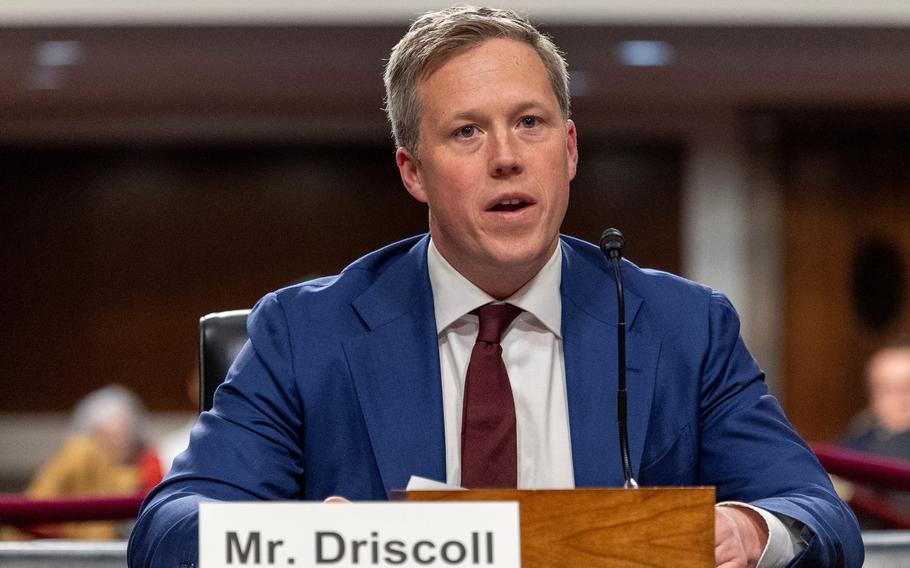
Secretary of the Army Nominee Daniel Driscoll

 https://www.stripes.com/incoming/attvw6-driscoll.jpg/alternates/LANDSCAPE_910/Driscoll.jpg

stripes.com

Hearings have begun on the appointment of Daniel P. Driscoll for the position of Secretary of the Army. A graduate of the University of North Carolina at Chapel Hill and Yale Law School, thirty-nine year old Driscoll spent a deployment in  Iraq with the 10th Mountain Division. Since leaving the military he has worked as an executive and investment banker.

If approved Driscoll would be replacing Christine Wormuth, the first female secretary of the army. While there's been some criticism of Driscoll's scope of knowledge of the Army, he seems to have the bulge on his predecessor, who was intent on the electrification of the army in the battle against global warming:

“The Army must adapt across our entire enterprise and purposefully pursue greenhouse gas mitigation strategies to reduce climate risks,” Secretary of the Army Christine Wormuth said in a statement. “If we do not take action across, across our installations, acquisition and logistics and training, our option to mitigate these risks will become more constrained with each passing year.”

  She graduated with a bachelor's degree in political science from Williams College in Massachusetts and a master's degree in public policy from the University of Maryland. We're not sure if her level of expertise includes both climate science and armored warfare, one or neither.


Tuesday, January 28, 2025

Cyber Espionage

Cyber world is an invisible and soundless expanse of communication and control that extends its grip through the technology that created it. 

Finally, we launched Project Upskill, a program designed to empower vulnerable populations with straightforward guidance to strengthen their cybersecurity. Over the past year, we’ve taken this initiative nationwide, supporting regional events across the country to provide tailored support and deliver this critical guidance directly to at-risk communities.

In a world increasingly reliant on technology, each of us plays a vital role in strengthening cyber resilience. By taking proactive steps—like the four simple steps of cyber hygiene; by encouraging universities to consider starting cyber clinics; or supporting high-risk communities—we can all Secure Our World. 

Before graphical depictions of speech, writing, keeping information secret was a matter of trusting those to whom one spoke. Writing and printing leaves a tangible record that can be deciphered by any one, friend or foe, in the future. That's why important government documents are labelled "TOP SECRET". Ex US presidents are hassled for keeping confidential information in cardboard boxes in their laundry rooms. An unrecorded conversation between two spies is more secure than a folder with a red letter warning across the first page.

Now, although the US government works hard at gleaning the plans of potential adversaries by intercepting their digital communications, they are even more dedicated to keeping their own accumulated information out of the wrong hands. Since these pixels are roaming around the internet they are vulnerable to capture by dark forces. Cryptology, hiding and disguising digital information, is as big and lucrative a field as finding the information itself. Its results can't be guaranteed and enormous efforts are made to improve the techniques of interpreting digital signals.

Since no one can know if a record or message of critical importance can be safely hidden from the bad guys lurking on the world-wide web maybe it shouldn't be exposed to the possibility. Everyone seems to be in love with modern technology but every aspect of it should be evaluated in terms of how effective it is for its intended purpose and the negatives involved. Instead of sending an important message over the web it might be better for the sender to whisper it in the ear of a trusted aide for personal delivery. That was a common method in days gone by and seems to have worked well.  

Monday, January 27, 2025

2040 Clean Energy Target

 Microsoft and Amazon have acquired property near Xcel's retiring Sherco Power Plant.

 Microsoft and Amazon have acquired property near Xcel's retiring Sherco Power Plant. Credit: Minnesota Pollution Control Agency

This photograph shows a portion of the Sherco Power Plant near Becker, Minnesota. It's included with an article that concerns expanding the production of electrical power to meet the needs of planned data center construction and operation.

As is often the case, the picture doesn't show the smoke stacks that release the combustion products of the three boilers at the plant. They're not dramatic enough. Instead, it shows the cooling towers that condense the steam produced in the plant back into water after its energy is used to turn the turbines that produce the electricity that turns the wheels of businesses and homes. The vapor rising from the cooling towers is water vapor, H2O in the form of a gas, the same substance that makes up  clouds. There's speculation that water vapor in  the atmosphere can increase temperatures but water vapor is not a pollutant and causes no harm to the environment. This picture is meant to confuse and misinform the viewer.

Sunday, January 26, 2025

The Data Center Fraud

 Federal officials say fast development of data centers is vital to the economy and national security, including to keep pace with China in the artificial intelligence race.

Exactly how are data centers "vital to the economy"? If they were, wouldn't the economy be in some kind of serious predicament now? Maybe it is but how is the absence of data centers responsible, since there haven't been any in the past or present? Keeping pace with China? Why? 

The data center problem is mostly about doubling the production of electricity in the country so that existing demand can be satisfied while stoking generation of power for artificial intelligence. The phony computer filing systems are an even bigger bonanza for the Whigs than the anti-CO2 renewable energy fiasco that's getting smaller and smaller in the rear view mirror. The design, financing and construction of the monstrous semi-conductor warehouses means huge dollars for those involved. The financing is the most interesting part in that the guys with the money aren't physicists and need to believe the spiels they're told about the potential profits of pixel storage, retrieval and reassembly. Nobody seems to have come up with an estimate of how many data centers will be needed to keep the economy chugging along while relegating China to an inferior position in the world hierarchy.

How many data centers will be needed to accomplish the goals? Since they will all be finding and storing the pixels off the internet, isn't it likely that there will be considerable redundancy in their inventories? Isn't it almost a sure thing that every data center will have a digital copy of Thomas Frank's "What's The Matter With Kansas?", Barak Obama's "The Audacity of Hope", and Al Gore's "An Inconvenient Truth" among all the other screeds in the history of publishing? If they are providing answers to questions, how are they different from a number of supermarkets in a neighborhood that sell the same brands of breakfast cereal and other products with different names but identical qualities? Sure, one data center could provide more accurate and valuable information than another but how would the buyer know this? 

The construction of the data centers, their consumption of immense amounts of energy, the costs of the jobs  promised, etc. mean that if the data centers are going to be businesses, some one will need to pay for the product they produce. Who will that be?

Imagine that an automobile manufacturer pays the operators of a data center for information on the  prospects of a kind of drive train. That's the sort of thing that will be sold, information on the possibilities of the future. Relevant knowledge of the past in such a situation is easy to come by, predicting the future has never been guaranteed. If a business buys a scenario of the future from a data center operator, how does it know that this info is exclusive or even correct? Won't the cost of that knowledge need to be added into the price of the car? In a capitalist system technological advances are meant to make products cheaper.

In the past and today, problems involving technology have been solved by engineers, who use computer expertise as they have slide rules and various math models. The information that they use isn't necessarily a secret but its implementation may be and probably is unique, which takes it out of the AI realm.

A different aspect of the AI program could be the total digital operation of a business, let's say an outboard motor manufacturer. A data center would have a digital interface with every moving part in that plant, no humans would be needed. Trucks would arrive at the loading dock with all the necessary raw materials and robots would unload them and direct them to the correct entry points in the continuous assembly process. Once completed the engines would be tested and then shipped maybe to dealers or directly to consumers. The role of contractors who supply various components may change or expand. How big would an outboard motor manufacturer have to be in order for such a situation to be financially feasible?

The market for information that will subdue the advance of China is basically limited to the US government. That's an important point for the Whigs since at least at this time the government has an unlimited amount of money to advance Whig operations. The validity of information needed to counter the godless commies, based on digital sources, isn't something that the US should base its foreign policy upon.    
Tuesday, January 21, 2025

What Will AI Actually Do?

On the heels of the Trump inauguration the AI confidence men have shown up to make America great again. By combining forces they have created "Stargate", a company that will keep the godless commies of China trailing the USA in AI and prevent their making slaves of the Yankees. 

Additionally, AI development will make every aspect of American life better and employ thousands of people in well-paid, meaningful jobs. The infrastructure, however, must be in place for this utopia to arrive. That will require money, more money than the operating businesses can round up. The government can take care of it.

The pro-AI profiteers have described the benefits of AI in only the most general terms. If AI is to be such a problem-solving benefit shouldn't it be really easy for them to point out some very specific problems or opportunities that AI will quickly tackle? In the military sphere, will AI be the director of defense research and procurement and then the planner of kinetic attacks and defense? Since AI only has access to material on the internet, which is the product of human intelligence, will it be able to produce genuine innovation or just a list of most likely options? Since billions are being spent on AI data centers wouldn't it be foolish to reject any AI suggestions or commands?

On a more mundane level will AI be used in the design and manufacture of consumer goods? Perhaps the billions of dollars spent on AI will yield more efficient washing machines, microwave ovens and blenders. For sure AI designed automobiles will end any arguments over the pluses or minuses of EV vs. ICE transport. Closing or building highways or bridges will be something that AI can do with no effective opposition. Building codes are a perfect area for AI use. Why haven't we heard more about the actual projects planned for AI? OK, they say that AI will be able to cure cancer.

Who will monitor the ethics of AI? No one knows what manner of control AI might recommend to address a perceived social problem. Will AI have a conscience? What if AI recommends or commands the extinction of some species of animals or even a given human population? How will the argument between the AI advocates and the post-modern Luddites be resolved? Sam Altman, Larry Ellison and Masayoshi Son and others should have ready answers to all these questions. What are they?   

The Minor Leagues of American Football

A game played between teams representing The Ohio State University and Notre Dame University on the evening of January 20th in Atlanta, Georgia resulted in a victory for the team from Ohio and defeat for the one from Indiana. The winner is considered the champion of NCAA football at the highest level.

While college football is immensely popular with the students, alumni, and residents of the state and surrounding area, the fact is that it's very much inferior to the professional model of the NFL. This is quite obvious since the NFL ranks are made up of the best players from college rosters. Even so, NFL games are filled with misplays and incidents that indicate that the players are either ignorant of the rules or ignore them, which results in many "penalties".

College football is thus the "minor league" of the NFL.

Major league baseball, on the other hand, generally prefers not to draw its players from the college ranks. Very few baseball players advance to the big league clubs without some experience, often a lot, in the minor leagues, teams that give young players an opportunity to learn the basics and nuances of the game. These leagues are financed by major league affiliates and gate receipts. 

The highest level of professional baseball under the major leagues is the AAA League, made up of the International League and the Pacific Coast League. Teams like the Durham Bulls, Toledo Mudhens, Albuquerque Isotopes and Salt Lake Bees, thirty in all. The two branches of the AAA League select their playoff participants on the basis of a split season result, one team that has the best record in the first half of the season the other the last half. The winners of each  of the three game series play a single game for the AAA League Championship.

Most sports fans are probably unaware that the 2024 AAA Championship game was played on Sept. 28 at Las Vegas Ballpark between the PCL representative Sugar Land Space Cowboys from Houston and the IL Omaha Storm Chasers from Nebraska. The Space Cowboys won the game 13-6, a rather football-like score, in front of 8,007 fans.

The point is that this contest, between the talented veterans of a 148 game regular season, has much more athletic validity than a college football game at any level, or even an NFL game.    

A Ride In A Chinese AV