Sunday, October 27, 2024

AdF Doesn't Like Bauhaus

Bauhaus, the architectural design school created in Germany in 1919 and for some odd reason still influential in many parts of the world, is a contentious subject in East Germany, according to Reuters. 

Bauhaus itself isn't the issue. It's those who object to boxy, ugly brutalist buildings replacing traditional structures. Those objectors are attempting to make a point that was also that of 1930's Nazis. That makes them the heirs of the Nazi culture. 

Architectural Adventures: Bauhaus and Beyond | ArchDaily

archdaily.com

Members of the Alternative for Deutschland., invariably designated in the press, both locally and internationally, as "far right wing", aren't in favor of new construction following Bauhaus ideas so they are Nazis. It's important not to continue or resurrect atavistic Nazi concepts. But current Germans and in fact people all over the world drink beer, eat sausages,  and brush their teeth just as the Hitlerites did. But they are not labelled as Nazis.

What makes the AdF neo-nazis is their refusal to accept as normal idiotic government policies. They oppose what has become unlimited immigration and government subsidies for the invaders, similar to what is occurring in the US. They also oppose involvement in the Ukraine-Russia fiasco and favor diplomacy being used to settle an issue with the potential of destroying modern civilization. The AdF finds the efforts to eliminate climate change as futile and destructive of the German economy, both for business and ordinary citizens. Apparently that makes them Nazis, at least in the eyes of their political adversaries. It's similar to what is occurring in the US where politicians label their electoral opponents as fascists or commies. It's just easier that way.       

Thursday, October 24, 2024

Jake Sullivan Defends Tariffs On Chinese Imports

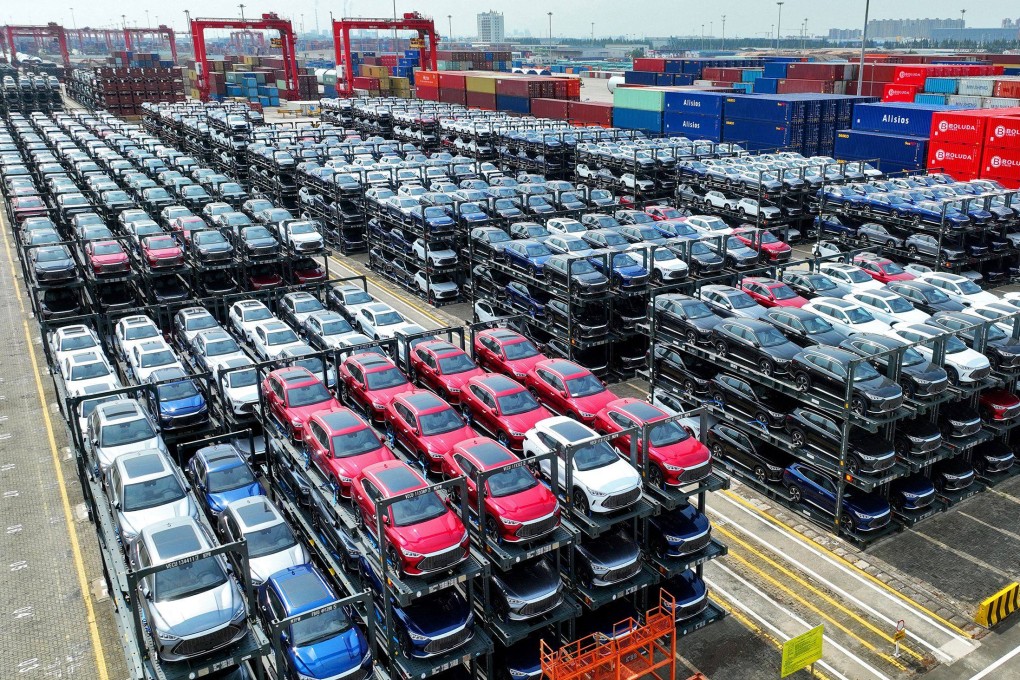
 Electric vehicles by Chinese car maker BYD stacked and ready to be loaded on a ship at Suzhou Port, Jiangsu Province. Photo: AFP

The SCMP keeps track of US China policy for us, kind of. In an article about the administration's ideas on tariffs on Chinese imports as expressed by US National Security Adviser Jake Sullivan at an event at the Brookings Institution he informs us that  Biden’s approach on China represented a return to “a tradition” of American foreign policy based on the concept of “self-interest rightly understood”.

In 2023 the US imported, mostly from Canada and Mexico, USD 210.3 billion in automobiles from 87 countries. Manufacturers in mainland China shipped $2.5 billion in cars or about 1.2% of US imports.


Wednesday, October 23, 2024

Lowest Sea Level Ever Recorded

On Saturday, Oct. 12 the sea level dropped 7.9 feet below the low tide line, the lowest ever recorded at Nome, Alaska. If this sort of thing continues, no doubt due to climate change, bad things will happen in the Bering Sea, whales and walrus might starve or be eaten by polar bears. Seals will head south. Ducks and geese will get out of town for sure.

                                                photo by Anna Leotis  Nome Nugget


Saturday, October 19, 2024

Haitian Rice and Firearms


Spanish English-language on-line news portal El Pais carries an opinion piece on the travails in Haiti, a place well known for unpleasant disasters for the population. This comes because rumors have been going around about Haitians living in Springfield, Ohio eating the local's pets. The article goes on to describe the verifiable problems of the country.

To begin with no mention is made of the fact that Haiti, an island country, shares the island with the Dominican Republic. Certainly through the years the Dominican Republic has had its own share of problems but nothing on the scale of Haiti. The Dominican Republic frequently gets in the news because it's a primary source of US major league baseball stars, not for overpowering social problems.

 Hispaniola

ar.inspiredpencil.com

The satellite photo shows two very divergent landscapes on the same island, one green and healthy, the other barren. Come to your own conclusion.

The writer makes two salient observations: 1. That the endemic violence of Haiti is caused by illegal arms importation Florida gun runners. 2. The domestic rice production of Haiti was destroyed by US President Clinton forcing them to abandon a rice tariff meant to improve the agricultural economy of Arkansas.

In regard to claim #1, arms dealing is meant to be a profitable enterprise for the dealer, who expects to make money on the transaction. In this case, from where do the funds for arms purchases come in a place noted for its poverty? Furthermore, in order for a gun of any kind to be effective ammunition is required. No ammunition is manufactured on Haiti either. It must be purchased, at a premium, from Florida gun gangsters.

Statement #2 makes the point that  a tariff on imported rice was beneficial to Haitian rice growers and its termination meant that rice was no longer grown on the island. This is a common misconception of what tariffs are meant to accomplish and the actual result. In this case, as in all other tariff situations, it raised the price of rice for consumers. Clinton's economic diplomacy meant that without the tariff rice became cheaper. Perhaps that made more funds available for arms purchases.

In any event, neither of the two issues addresses the high level of violence in Haiti. It's apparently deeper than lots of guns and cheap rice.   


Thursday, October 17, 2024

Bill Clinton and Chuck Schumer Both Advocate Increased Immigration

 Former President Bill Clinton speaks in support of the Harris Walz presidential campaign d

juliabeverly getty images


Former Rhodes Scholar and US President Bill Clinton maintained in a speech at a fish fry that immigration was necessary to maintain the economic growth that makes the US such a nifty place because US women are refusing to reproduce. Oswald Spengler predicted and explained this phenomenon years ago in his classic "The Decline of the West".

As many Yankees are coming to realize, increasing amounts of immigration won't produce a dynamic US economy but instead will result in a different national entity as time goes by. Just as the invasion by Europeans eliminated the native cultures and populations in and after the dawn of the 16th century, immigration to Europe and North America will eventually mean the birth of a new culture. All the riches that were showered on the military-industrial complex to prevent the Bolsheviks from changing Texas to a warmer and more Baptist Siberia will have been wasted.

The elites of the West apparently believe that they and their maybe descendants will be insulated from such a development, the current proles just being replaced by a more exotic harmless version. The Ivy League alumni will still be the decision makers.

We regularly hear about the impending doom of Japan from a diminishing birth rate. In fact, we've been hearing about it for many years. But Japan is still around, doing odd Japanese things that are authorized or ignored by the US, who is using the island chain as an advance aircraft carrier in the western Pacific.

The concern over a falling US birth rate has nothing to do with preserving the country as a society or culture. If it did, obviously the educational system and other cultural influences would talk females out of aborting their unborn. This they have not attempted to do. So replacing the deceased isn't about continuity, or sustainability, currently a favorite word, but instead, like everything else, an issue of wealth.

The fertility rate doesn't need to drop very much before the financial mavens worry about the most serious problem, consequent declines in asset values. Most concrete assets decrease in value when the surrounding population falls, except perhaps senior living facilities. Most of the time assets are purchased with the expectation that they will either produce income or increase in value. Homes on the fruited plain aren't just places to live. The idea that they will increase in value makes them an investment, a source of funds for tuition at the senior living facility. For business, real estate is the best security for loans, as long as it increases in value.

A trip through rural America demonstrates how it works. Small towns are, for lack of population, shuttering their operations. Agriculture, the most important industry in the world, now needs a fraction of the work force it once did. The farm land prices are rising but the homes and businesses in the villages are closing up. A decline in fertility will spread this affliction everywhere if immigrants aren't allowed to replace Americans. Someone must pay the rent on the many thousands of new apartments still being built in the suburbs or the banks may be offended.      

Tuesday, October 15, 2024

Private Equity Goes After The Plumbers

In a top-of-the-fold, front page exposure on Oct. 14, the WSJ highlights what they believe to be a significant change in the US economic picture, private equity firms buying their way into the mechanical service and construction industries. The article fails to mention that the same occurred in a slightly different guise twenty-five years ago. In 2000 US Filter bought a number of western US mechanical contractors. They were following the lead of other consolidators who anticipated a gold rush in infrastructure development, particularly in the growing computer hardware field. This trend, interrupted by the twists and turns of the national economy has continued to this day.

The real question, if there is one, is whom this phenomenon benefits and how much? No doubt some players see that the replacement of obsolete boilers and the introduction of supposedly more efficient heat pumps to take advantage of government subsidies related to the fight against climate change are an opportunity not to be ignored. Simply taking over the family businesses that have been the focus of mechanical service until now probably isn't the ultimate aim. 

The mechanical trades are a tough business. Heavily unionized in the most lucrative areas, they require management with sharp pencils for successful bidding and experienced work crews with highly developed skills. As in many other businesses, the success of the private equity buyers will be contingent on the workers in the field more than the ownership.  


Friday, October 11, 2024

A New Executive Vice President For Finance And Operations At The University Of Minnesota

Portrait of Goldman over a blurred image of fall foliage

Gregg Goldman


Following approval by the Board of Regents today Gregg Goldman will be taking the financial reins of the University of Minnesota on November 11, replacing interim Senior VP Julie Tonneson who replaced Myron Franz on March 1, 2024.

There's been scant information on Goldman's career up to this point. Goldman's age hasn't been mentioned. He has made brief stops at UCLA and Hillspire LLC, the entity that keeps track of Google co-founder Eric Schmidt and wife Wendy's philanthropy and other financial interests to the tune of $20 billion. 

Where Goldman's CV becomes interesting is his tenure prior to UCLA, at the University of Arizona. Tony De Francesco also went on to UCLA. The situation in Arizona  has led to a $10 million law suit. There's a possibility that Mr. De Francesco could eventually have a position in Gopherville as well.

The romance of Mr. Goldman is more interesting yet: