Thursday, April 12, 2018

Autonomous Autos and the Future

Image result for autonomous auto
According to just about everybody, the future is now for the autonomous automobile. Self-driving cars will soon dominate US streets. The ramifications of this, the legal issues, are pointed out here. The lady fails to mention some even more important inevitable outcomes should self-driving cars become "normal".

It must be assumed that autonomous automobiles will comply with traffic laws in every way. They won't speed, run red lights, or pass in a no-passing zone. According to the Bureau of Justice Statistics, a government agency, 42% of the face-to-face encounters between US residents and police is during a traffic stop, about half of which result in tickets. Should well-behaved self-driving cars eliminate this, we would ostensibly need about half the cops and squad cars now employed in traffic regulation. At the same time, there would no longer be any municipal income from traffic fines. This source estimates that the annual fines in the US for speeding add up to $6,232,000,000, or about $300,000 per year per police officer. The $6 billion + that towns and counties collect must be replaced through some other means, probably higher taxes.

While the constitution puts limits on the ability of law enforcement to invade a private domicile, traffic stops are a different story. A crooked license plate can be probable cause for a traffic stop and a subsequent search of the car and driver. This shouldn't be a problem with the carefully maintained and law-abiding autonomous autos. Thus criminals smuggling drugs, cash, rare falcons or stolen art will be much more difficult to apprehend, especially because there will be far fewer police on the road. An increase in drug usage is likely.

Drinkers will be quick to adopt self-driving cars. This will make the highways safer but also increase general drunkenness, since there would be no reason to restrain one's drinking in order to avoid DUI arrest.

A supposed major benefit of autonomous cars will be increased highway safety. If so, this too will have unintended effects. Structural fires are a small part of the activity of fire departments. Many of their calls are in response to accidents, specifically car accidents. A dearth of car wrecks and the consequent injuries will mean even less for firemen to do and require fewer men at the firehouse. 

Local government will have an interesting time adapting to a crime-less automobile environment. Finally, the aspects of this issue are mentioned in cutting-edge on-line publication Wired.


Monday, April 9, 2018

Sadiq Khan & Knives

London Needs You Alive - don't carry a knife
Mayor of London Sadiq Khan has established a movement to prohibit knives in the British capital, shown on a city website.

Mayor of London Sadiq Khan

His honor the mayor of London, demonstrating his affinity with the common man by going tie-less. And knife-less.

It might be the natural reaction of a non-thinker to blame perhaps man's first tool for an epidemic of violence in the world's most cosmopolitan city but, of course, that would be wrong. Khan says on his Twitter feed: "No excuses: there is never a reason to carry a knife. Anyone who does will be caught, and they will feel the full force of the law."

Actually, there are many legitimate reasons for carrying a knife, today as at anytime in the past.

 Related image

A neolithic stone knife from Denmark, probably more than 6000 years old.

More modern knives are used for many daily tasks, opening packages, sharpening pencils, cutting up a steak, modifying a sweatshirt and on and on. While knives may in fact be used in acts of mayhem, the ordinary man that carries a knife every day seldom employs it in eviscerating one of his fellows. In much of the world, a good knife is almost an item of jewelry and a signal of masculinity. Forbidding the possession of such a simple, commonplace tool seems like a serious intrusion by any level of government. This policy would be ignored and laughed at over most of the planet.
Ultimately, knives, their construction and use, are one of the major differences between men and monkeys. Not being able to make knives, and having no pockets in which to carry them, monkeys can't peel mangoes, trim their nails, open packages or slice up a watermelon. If a monkey invites you to a picnic, you better have a knife to slice the watermelon because the monkey won't. In fact, he might be inviting you in the hope that you'll divide up the watermelon for all his friends.

Sunday, April 1, 2018

More on Trump's Wall

We talked earlier about Trump's Wall, a planned physical barrier meant to stop the passage of non-US citizens across the southern border of the country into economic and social paradise in this post.

Upon reflection it doesn't seem that a terrestrial version of the proposed wall will be much of a problem in that such walls are now quite common in the US, at least in urban areas. These walls aren't meant to arrest human travel, however. Their purpose is stop the invasion of noise. They are the common noise barriers erected between limited access highways and populated neighborhoods.

There has been much experience in the erection of these walls so the project should be a simple and relatively inexpensive one.

Image result for freeway sound barriers
Simple and inexpensive wall meant for sound abatement but probably effective in stopping access to the freeway. We might see a few thousand miles of this in the near future.

Sunday, March 25, 2018

Little-known Lady To Be Honored With Statue

that takes the place of a little-known Confederate general.
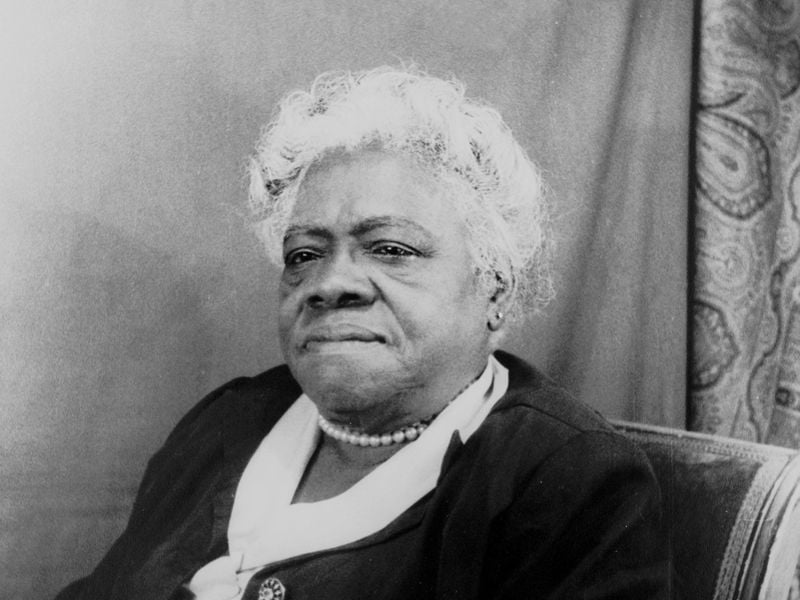
Mary McLeod Bethune in 1949. Photo courtesy of the Carl Van Vechten Photographs collection at the Library of Congress.
Mary McCloud Bethune

As explained in this article from artnet.com, a statue of Ms. Bethune will soon represent Florida in the the US capital's National Statuary Hall, replacing that of Civil War Confederate general Edmund Kirby Smith, whoever he was.

The removal of statues that commemorate failed military leaders, or even successful ones, and their replacement by those of important contributors in other spheres is admirable. But why are three-dimensional images of southern white males of the War Between the States era the focus of banishment?

While the slavery of American blacks deserves some form of approbation, does it really compare in misery to that of the native Americans, once owners of the entire continent, subjected to near genocide by a technologically superior society,  now barely surviving on the most inhospitable portions of the country? Were the slave-holding southerners expected to simply release their human property because William Wilberforce and Charles Sumner felt that was the right thing to do? And then what?

The former slaves became bonafide US citizens in 1866, native Americans weren't extended this status by the all-powerful state until 1924. The aftermath of the War Between the States included the formation of several all-black military units, the "Buffalo Soldiers" whose job was to continue the extermination of the plains Indians under the policies of General Phillip Sheridan. "Little Phil", who was quoted as saying that "the only good Indian I ever saw was a dead one", is honored to this day with statues, street names, and even the names of towns.

Image result for Philip Sheridan Statue
 
Phillip Sheridan statue in Sheridan Circle, Washington, DC, just a few blocks from the National Statuary Hall.

Native Americans are behind the effort to rid the country of statues of others instrumental in their subjugation, as explained here.

William McKinley, whose statue is the center of controversy in the northern California hamlet of Arcata, is not only depised by native Americans for his policies, but also by Hawaiians for signing the Newlands Resolution that annexed the islands in 1898. He's no hero in what's now the 50th state but was once the Republic of Hawaii. 

Monday, March 19, 2018

Selling Leadership

Once upon a time educational institutions were in the business of education, adding to the learning ability of students and increasing their knowledge. In their ongoing effort to serve student/consumers, and maintain enrollment, they're attempting to peddle changes in social relationships between their graduates and the rest of the world. They're now selling leadership.


It's always been our position that leadership is a quality that really can't be taught. The military academies, whose primary purpose is to mold good students into martial leaders, can't actually do so. Most military officers are individuals that fit well into an existing structure. Their leadership qualities are often only recognized by the insignia on their clothing and their ability to adhere to bureaucratic procedures.

 
 The concept of leadership itself implies followers. After all, leaders must have acquiescent followers in order to be leaders. In fact, there must be far more followers than leader.


This sign over the entrance to an elementary school probably can't be read or understood by most of the students. It's purpose is probably to make parents happy about the prospects for their children, whom they do not wish to become followers. It's implicit that it's better to be a leader than a follower and that attendance at Jefferson School will assure this outcome.

Even a cursory historical analysis indicates that a huge proportion of leaders have led their followers down destructive paths, for both themselves and others. Leaders initiate unsuccessful theories and negative actions, many of which don't become apparent until it's too late.

It might be better if the educational process produced people that were determined to mind their own business rather than a minority that attempted to force their views on others.

Saturday, March 3, 2018

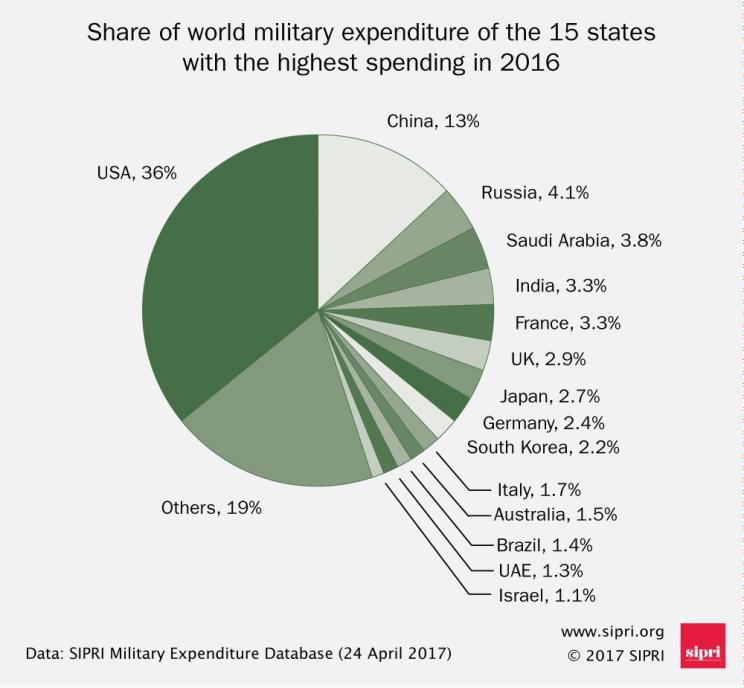
Rankings of World Military Expenditure

https://www.sipri.org/sites/default/files/styles/body_embedded/public/Figure_2_0.jpg?itok=PT1QQzbr

Facebook and Pornography

Along with helping the Russians get Donald Trump elected to the US presidency, social media giant Facebook is under fire for its algorithm that identifies nudity as pornography and removes it as "inappropriate content".

The latest censorship incident involves the "Venus of Willendorf", a 30,000 year old statue discovered near Vienna in 1908 that currently resides in the Naturhistorisches Museum in the Austrian capital, as explained here.

The Venus of Willendorf
As is also explained in the article, this isn't the first time that there's been controversy over Facebook censorship. Famous 19th century French artist Gustave Courbet's 1866 painting " L’Origine du Monde" was included in a Facebook post that resulted in the closing of an account, although it hangs today in the Musee D'Orsay in Paris. Artnet News weighs in on the matter here.

 Origin-of-the-World.jpg
L'Origine du Monde

The Facebook policy brings up some interesting questions. If they can rightfully refuse to carry what they consider pornographic, who else can do the same? Facebook is in the business of accommodating the public, just like people that bake wedding cakes. Do they have the right to censor not only images but also verbiage? Who is the judge of pornography? While there have been US Supreme Court decisions in this regard, who decides what is or is not pornographic in an individual case? How is it that ghastly images of death and destruction, murder, abortion, etc. are standard fare in all kinds of media, including Facebook, but a nude female, certainly familiar to almost everyone and a threat to no one, is forbidden? If Facebook, in its role of accommodating the public, can refuse certain images or ideas, what of other businesses? Can the power company disconnect the electricity of art galleries festooned with nudes?

 Image result for no shirt no shoes no service